
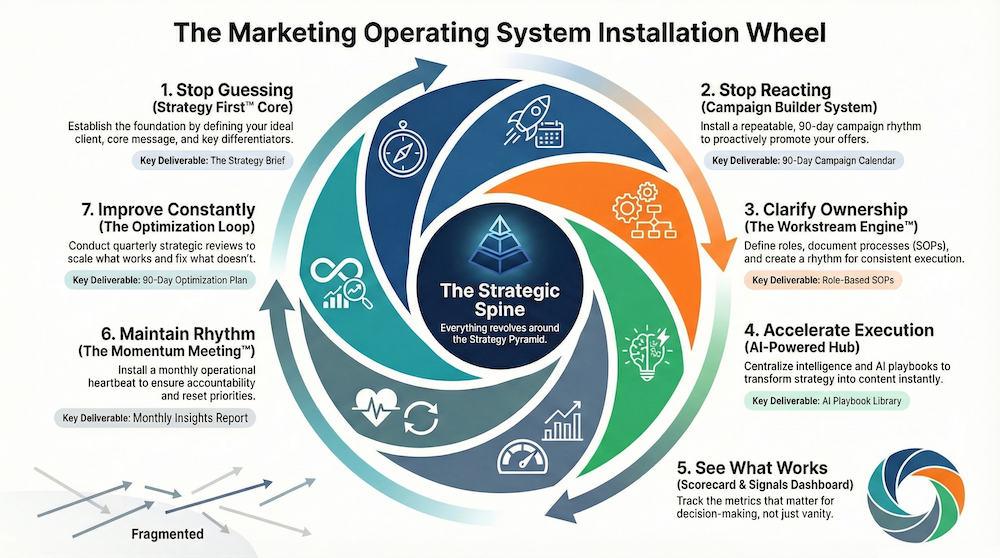
How to Move From Random Acts of Marketing to a Scalable, Predictable Growth System
Table of Contents
Introduction: Strategy Isn’t the Problem
For years, we’ve said it: Marketing is a system.
Most business owners nod in agreement. But very few actually treat it like one.
Instead, what we often find is this: campaigns are built in isolation, tools get added reactively, teams stay busy — but results stay unpredictable.
The problem isn’t strategy. It’s the lack of a system to run that strategy.
When Marketing Lacks a System, Everything Feels Harder
If your marketing feels disorganized, reactive, or overly dependent on a few high-performers to hold it together, you’re not alone. That’s not a marketing problem. It’s a systems problem.
Here’s what it looks like in the wild:
- Priorities change week to week
- Campaigns launch at the last minute
- Results are hard to explain or scale
- Tools and platforms aren’t integrated
- Leadership doesn’t know what to invest in next
Even successful businesses experience this behind the scenes. Growth may be happening, but it’s fragile. It depends on effort and intuition, not structure.
Why Strategy Alone Falls Short
Most businesses have some kind of strategy — or at least a slide deck with one.
But strategy doesn’t:
- Set monthly and quarterly priorities
- Assign ownership across people and teams
- Decide what gets launched — and what doesn’t
- Convert insight into repeatable execution
Without a system, strategy becomes a one-time conversation instead of an ongoing guide.
What Is a Marketing Operating System?
A Marketing Operating System (MOS) is not software. It’s not a campaign calendar. And it’s not a tech stack.
It’s a structured approach for running marketing — all year long.
A solid MOS answers five essential questions:
- What matters most right now?
- Who owns what?
- How does work flow?
- How do we measure progress?
- How do we decide what to change next?
When these questions are consistently answered, marketing stops being reactive and starts compounding.
Want to find out if the MOS is right for your business? Book a strategy call
The 5 Core Components of a Marketing Operating System
Let’s break down what a functional, scalable MOS actually includes.
1. Strategy First
Every strong system starts with a clear direction. That means defining:
- Your ideal client
- Your positioning and point of differentiation
- A short list of strategic priorities
- The complete customer journey
This becomes your filter. Without it, your team defaults to what’s urgent — not what’s important.
2. Campaign Planning & Prioritization
Campaigns shouldn’t be surprises.
An MOS creates a predictable campaign rhythm that:
- Ties directly to strategy
- Sequences campaigns intentionally
- Aligns outcomes with business goals
- Gets planned quarterly, not in a rush
This creates calm, not chaos.
3. Roles, Workflows & Operating Rhythm
Without clearly defined responsibilities and workflows, marketing turns into guesswork — or worse, heroic efforts.
A true operating system outlines:
- Who owns which parts of the engine
- How tasks move from idea to execution
- Where decisions are made
- How internal teams and external partners collaborate
With this in place, marketing becomes scalable and sustainable.
4. Measurement That Informs Decisions
A healthy MOS doesn’t track everything — it tracks the right things.
Focus on:
- A handful of critical KPIs
- Signals that guide smart decisions
- Regular (but not obsessive) review cycles
The goal isn’t to prove activity — it’s to enable better investment of time, money, and energy.
5. A Consistent Leadership Cadence
Systems don’t run themselves. Someone has to steer.
A Marketing Operating System needs a clear owner who:
- Sets priorities
- Makes tradeoffs
- Interprets metrics
- Guides iteration and improvement
Without this leadership layer, systems degrade and decision fatigue creeps in.
Why AI Makes This More Urgent — Not Less
AI has revolutionized how fast we can create and execute marketing tactics.
But AI can’t tell you what should be done.
And without a system, it can actually make the chaos worse — more content, more ideas, more busy work.
Within a Marketing Operating System, AI becomes leverage.
Outside of one, it’s just noise.
What Changes When You Install a Marketing Operating System
When you commit to running marketing as a system, things get noticeably better:
- Strategy gets activated — not just documented
- Campaigns align to real business goals
- Teams know what to do and why it matters
- Tools and data connect into workflows
- Leadership finally sees the full picture
You stop reacting and start building momentum.
The shift isn’t about doing more — it’s about doing the right things with less friction.
This Is a Leadership Conversation
If marketing still feels like a recurring problem to solve, this is your moment to reframe the question.
Don’t ask:
“What should we do next?”
Ask:
“How should marketing operate inside our business?”
That shift leads to structure.
Structure leads to momentum.
Momentum leads to sustainable growth.
Conclusion: Less Friction, More Momentum
Marketing doesn’t fail because people aren’t trying.
It fails because it wasn’t designed to function well in the first place.
Installing a Marketing Operating System won’t eliminate the work.
But it will eliminate unnecessary confusion, misalignment, and wasted energy.
And that’s what makes marketing a driver of growth — not a source of stress.
Want to find out if the MOS is right for your business? Book a strategy call
FAQs: Marketing Operating System for Small Business
Q: What exactly is a Marketing Operating System?
A: It’s a structured approach to running marketing across your business. It connects your strategy to daily execution, planning, measurement, and leadership rhythm.
Q: Do I need special software to build this?
A: No. This is about process, not platforms. Tools support the system, but they don’t create it.
Q: How long does it take to install a Marketing Operating System?
A: Most businesses can establish the foundation in 30–60 days with the right guidance and ownership.
Q: Is this just for big companies with large teams?
A: Absolutely not. In fact, smaller businesses benefit most — because it reduces the chaos and helps small teams do more with less.
Q: How does this work with AI tools like ChatGPT or Jasper?
A: AI can amplify your system — but only if you have one. A MOS gives you the strategic and operational clarity to use AI effectively, instead of just generating more content.
Comments are Closed